

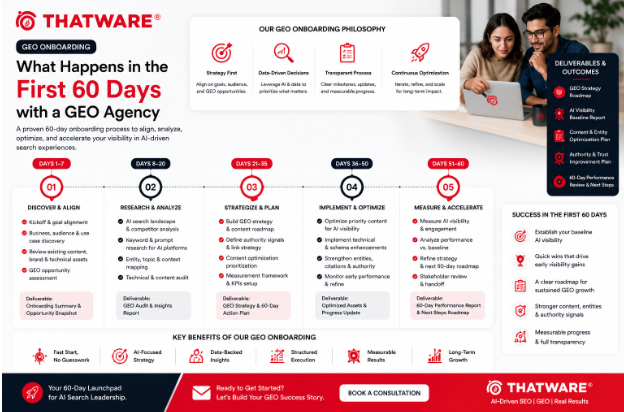
There’s a moment — somewhere around day three of working with a new agency — where you either think “okay, these people get it” or you quietly start drafting a polite exit email. That moment matters more than most clients realize. Especially when you’ve just decided to hire GEO agency talent for the first time and you’re not entirely sure what to expect.
Generative Engine Optimization is still relatively new territory. ChatGPT, Perplexity, Google’s AI Overviews, Bing Copilot — these aren’t your grandfather’s search results. Getting your brand cited, referenced, and recommended inside AI-generated answers is a different game entirely. And the onboarding process? It tells you everything about whether your agency knows what they’re doing.
So let’s talk honestly about what those first 60 days actually look like — the good, the sometimes-messy, and why the foundation laid in this period determines almost everything that follows.
Week One: More Questions Than Answers (And That’s Fine)
The first week is discovery. If your agency skips this or rushes through it, that’s a red flag worth noting. A good GEO team is going to ask you things that might feel oddly philosophical at first — not just “who are your competitors” but “how do people talk about your brand when they’re not talking to you directly?”
They’re building a picture of your entity footprint. That’s the term for how your brand, products, and subject matter expertise appear (or don’t appear) across the web in a way that AI models can recognize and trust.
Expect intake questionnaires, a few calls, and requests for access — your CMS, your existing content library, analytics if you have them. Some agencies send a proper discovery brief; others prefer workshops. The format matters less than the depth. You want them poking at things that haven’t been poked at before.
This week is also when the agency starts auditing how you currently show up in AI-generated responses. They’ll run queries in ChatGPT, Perplexity, Claude, and Google’s SGE environment. They’re asking: does your brand get mentioned? If so, in what context? If not — why not, and what’s filling that gap?
Days 8–21: The Audit Phase Nobody Warns You About
Here’s something clients often don’t expect: a lot of the early weeks involve looking at what you’ve already built. Not just your website. Your entire knowledge graph presence — Wikipedia mentions (or lack thereof), schema markup, third-party citations, forum discussions, review aggregators. All of it.
GEO optimization services go well beyond content writing. The audit phase maps where the gaps are between what your brand knows and claims versus what AI systems can verify and surface. Think of it like building a case for why an AI assistant should trust you enough to recommend you.
During this phase, your team might surface things like:
- Inconsistent NAP data (name, address, phone) across directories — still matters
- Missing or thin structured data on key pages
- Topic clusters your brand should own but doesn’t have authoritative content for
- A mismatch between how you describe yourself and how third-party sources describe you
It’s not always comfortable. Sometimes the audit reveals that years of “good SEO” have produced a site that looks fine in Google Search Console but is basically invisible to an AI summarizing the best vendors in your space. That gap — between traditional search visibility and AI visibility — is exactly what GEO addresses.
Weeks Three and Four: Strategy Takes Shape
By now, the agency should be presenting something concrete. Not a vague “content plan” with a lot of buzzwords, but a structured approach that includes:
Prompt landscape mapping — the specific questions people are asking AI tools in your niche, and where you need to show up inside those answers.
Entity optimization priorities — what information about your brand needs to be cleaner, more consistent, or more widely distributed across authoritative sources.
Content gap analysis — specific pieces that need to be created or restructured to signal expertise in your core topics.
A quality agency won’t just hand you a doc and disappear. There should be a collaborative review. This is where you can push back, ask questions, and make sure the strategy reflects how your business actually works — not a template they copy-paste for every client.
One thing worth watching for: does the agency distinguish between short-term wins and structural work? Some GEO improvements show up relatively quickly (schema fixes, structured citations, certain types of content). Others — like building topical authority that AI models recognize — take months. An honest agency tells you which is which.
The Middle Stretch: Days 30–45
This is where execution starts and, honestly, where things can slow down a little. Not because the agency isn’t working — but because GEO work at this stage is largely foundational. You might not see dramatic changes in your AI visibility reports yet. The temptation to panic is real.
Don’t.
Building the kind of brand presence that AI systems consistently pull from isn’t a two-week project. The agency is (or should be) doing things like publishing authoritative long-form content targeting specific AI prompt clusters, building or cleaning up third-party citations, adjusting structured data, and potentially starting outreach for earned mentions in sources that AI models tend to trust.
This stretch also usually includes regular reporting cadence — weekly or biweekly. What you want to see isn’t just activity logs (“we published three articles”) but impact-linked reporting: how has your AI citation rate changed? Which prompts are you now appearing in that you weren’t before?
Ask those questions. Good agencies welcome them.
Days 45–60: Signals Start Emerging
By the end of the second month, you should start seeing something. Not necessarily dramatic results — but signals. Maybe you’re getting cited in Perplexity for a question you weren’t mentioned in before. Maybe Google’s AI Overview now includes your brand in a category roundup. Maybe traffic from AI referrals has ticked up slightly in your analytics.
These early signals matter enormously — not because they prove ROI yet, but because they show the strategic direction is working. A well-run GEO engagement tracks these obsessively in the early days because they’re both encouraging and instructive. They tell you which content angles are landing, which entity associations are sticking, and where to double down.
This is also when a good agency revisits the original strategy with fresh eyes. What’s working faster than expected? What needs a different angle? GEO is iterative — the 60-day mark is a checkpoint, not a finish line.
What the First 60 Days Actually Tell You
Working with a GEO agency in those first two months reveals a lot — about them and about your own brand’s digital maturity. It’s a weirdly honest mirror.
The best agencies are organized but not rigid. They’re curious about your business, not just your keywords. They communicate when things are taking longer than expected, and they don’t oversell what GEO can do in a short timeframe. And they’re genuinely excited about the work — because this field is genuinely exciting.
If you’ve been thinking about whether it’s the right time to explore GEO optimization services for your brand, the honest answer is: the best time was probably six months ago. The second-best time is now. AI-driven search isn’t a future trend anymore — it’s where a growing chunk of discovery, research, and purchasing decisions are already happening.
The first 60 days won’t transform everything. But they’ll build something real — and they’ll tell you whether you’ve found the right partner to build it with.
The brands that show up consistently in AI-generated answers aren’t there by accident. They’ve done the unsexy structural work. Onboarding well is where that work begins.